
From Aid to Instability: How UN Budget Cuts Threaten Bangladesh’s Future
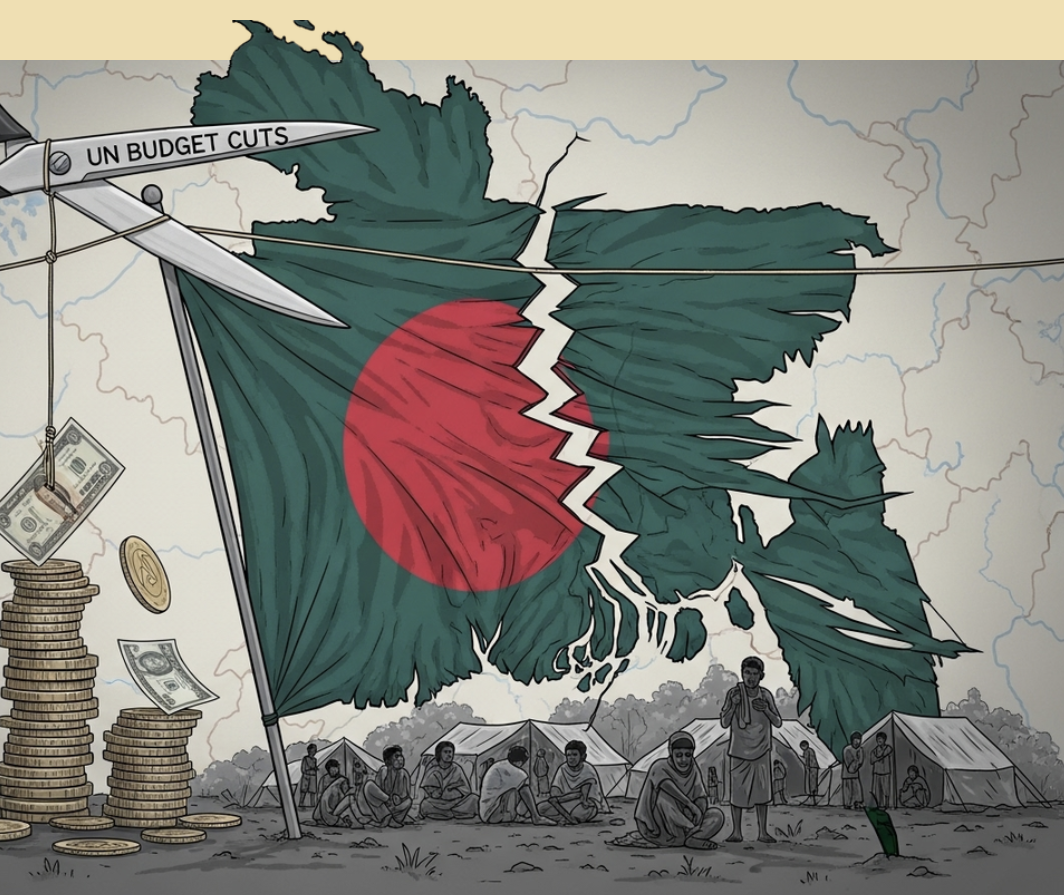
Written by: Ajwad Karim Shawmik & Ummi Hani Jamima
This article was originally published in the 14th edition of the Equilibrium magazine of North South University, Young Economists’ Forum
Introduction
The most frequent reason for forced migration worldwide is struggle. The Rohingya issue in Burma, where approximately 75% of the country’s Muslim population fled to neighboring Bangladesh due to violence and ethnic cleansing, has garnered significant attention.
This stateless Muslim minority now faces a new threat: declining international help. With no other option, the Rohingya population had to leave Myanmar in 2017 due to a deadly military campaign. Possible reductions in humanitarian aid might destabilize brittle support networks and drive one of the most vulnerable people in the world further into despair as the focus turns to other disasters.
The Rohingya crisis is not just Bangladesh’s burden; it is a global failure. Cutting aid saves budgets, but costs lives, fueling suffering that history will not forget. As a mother in the Kutupalong camp asks, “If the world abandons us, who will tell our story?”
Background of UN Assistance to the Rohingya in Bangladesh
Before the 2017 Rohingya arrivals, this administration and the United Nations High Commissioner for Refugees (UNHCR), the UN-level executive for refugees, offered part-time security and standard aid to roughly 31,000 registered Rohingya refugees from Burma living in two official camps (United Nations High Commission for Refugees, 2017).
The situation in the Rohingya camps is difficult and below acceptable standards. Individuals encounter congestion, insufficient housing, few sanitation options, limited availability of clean water, restricted healthcare access, and the absence of vital services. These circumstances intensify their susceptibility to health threats, exploitation, and safety issues.
After the 2017 exodus, the World Food Programme (WFP) fed 880,000 refugees monthly, while UNICEF and WHO ran 95% of camp health facilities and immunized 500,000 children annually (Over 500,000 Children Reached With Life Saving Vaccines by Ministry of Health, Supported by UNICEF & WHO, n.d.). The United Nations Development Programme (UNDP) aids climate resilience, constructing 4,000 cyclone shelters and training 76,000 volunteers (UNDP, n.d.). UNICEF’s education programs target 400,000 Rohingya children with informal schooling, though formal education remains restricted (UNICEF, 2023).
Impacts of UN Budget Cuts
The United Nations has long been a pillar of support for Bangladesh, providing crucial assistance in disaster management, refugee aid, healthcare, education, and poverty reduction. Reductions in the UN budget may impair these initiatives and put coastal communities at risk. Without strong UN backing, Bangladesh’s ability to tackle concurrent crises, climate impacts, refugee arrivals, and economic turmoil will diminish, threatening widespread displacement and increases in poverty.
The Rohingya refugee crisis presents an even more significant challenge. The Rohingya camps in Cox’s Bazar, 95% dependent on UN aid, face existential threats from funding shortfalls (UNHCR, 2023). Further cuts could collapse nutrition programs, spike malnutrition rates (already at 40% among children), and shutter 70% of health clinics. Desperation may fuel crime, trafficking, and radicalization in the overcrowded camps (International Crisis Group, 2023). UN budget cuts would unravel decades of progress in health and education. World Health Organization’s immunization programs, which eradicated polio and reached 500,000 Rohingya children annually, risk disruption, potentially reviving preventable diseases like cholera, and leading to a risk of health crisis in the Rohingya population. Maternal care, already limited to 1 midwife per 5,000 refugees, could collapse, endangering 60,000 pregnant Rohingya women (ReliefWeb, 2023).
For Bangladeshis, cuts to UNDP-funded community clinics and United Nations International Children’s Emergency Fund’s (UNICEF) primary education initiatives (which lifted literacy to 75%) could widen inequality, particularly for marginalized groups like climate-displaced families and urban slum dwellers (UNDP, 2022; UNICEF, 2023). WFP’s Food for Work programs, which employ 150,000 people in disaster-prone areas, might shrink, deepening unemployment (WFP, 2023).
Reduced aid would also strain Bangladesh’s economy, which spends $1.2 billion yearly on the Rohingya crisis funds that could otherwise bolster infrastructure or healthcare (Government of Bangladesh, 2023). A decline in UN-backed job creation could heighten social unrest, particularly in regions destabilized by climate migration and refugee pressures. For the Rohingya, who are already stateless and traumatized, reduced aid risks transforming a humanitarian crisis into a generational catastrophe (UNHCR, 2023).
As one mother in Kutupalong camp lamented, “Without rations, we will starve. Without schools, our children will forget how to hope.” The international community’s retreat risks abandoning not just the Rohingya but the principles of global solidarity.
Regional and Global Implications
As Bangladesh faces more significant socio-economic challenges regarding the Rohingya refugee crisis, it will hurt all South Asian countries, including India, Nepal, and Pakistan. These countries refuse to cooperate despite such implications due to their previous and ongoing clashes. According to Aamer (2023), as South Asian nations spoke at UNGA78 (UN General Assembly), they conveyed a message of solidarity , tenacity, and unwavering resolve in the face of global challenges. However, it is worth noting that there was limited emphasis on intra-regional cooperation within South Asia. While these nations articulated their commitment to addressing global issues, there was a missed opportunity to give weight to the importance of fostering regional stability through collaborative efforts on shared challenges, such as trade, security, climate change, and disaster management. With the facilitation of the UN, such regional cooperation could have yielded significant benefits. The Rohingya refugee crisis can significantly impact the security of South Asian countries, as crime rates have been increasing steadily over the past few years, and it is high time that we start cooperating to bring this threat under control.
As for global accountability and responsibilities, developed nations such as the United States and many European countries have shifted their priorities from addressing humanitarian crises and have started cutting down on funding humanitarian aid efforts, which has brought tremendous difficulty to Rohingya refugees and refugees all around the world. According to the UNHCR (2025), 95% of Rohingya households depend on humanitarian assistance. Plans by the World Food Programme to halve food rations to a mere $6 a month for Rohingya refugees in Bangladesh will have a devastating impact on their lives at a time when stretched resources have reached the limit.
According to Paul & McPherson (2025), the WFP stated that the funding shortfall results from an overall decline in funding rather than being expressly linked to President Donald Trump’s freeze on US foreign aid. UN Secretary-General António Guterres described humanitarian aid cuts by the United States and countries in Europe to Bangladesh, home to thousands of Rohingya refugees, as “a crime” (Garjon & Alam, 2025). Bangladesh has been urging the United Nations to find a solution for the situation in Rakhine state, creating a conducive environment for the return of the Rohingya population to their country (Muhith, 2023).
The Potential Path Forward & Conclusion
In light of the current negligence from big donor countries, Bangladesh has to reduce its dependency on foreign aid regarding the refugee crisis and focus on strengthening our economy and local governmental institutions in order to maintain our economy and the refugee crisis that we are dealing with at the moment. Perhaps partnering with different NGOs, The World Bank and IMF, asking for assistance for aid directly from developed countries instead of going through the UN, considering the role of the private sector in contributing to such matters, may help rectify the situation and bring hope for a future where the refugees can return safely to their homeland, and Bangladesh can be relieved of this dire refugee crisis on hand.
References
Asia Society. (2024, October). UNGA78 recap: South Asia’s diplomatic dispatch. Retrieved from
https://asiasociety.org/policy-institute/unga78- recap-south-asias-diplomatic-dispatch
Amnesty International. (2025, March). Bangladesh: The international community must
act to avoid devastating aid cuts for Rohingya refugees. Retrieved from
AP News. (2025, March). Bangladesh: UN’s Guterres condemns aid cuts as a crime.
Retrieved from
Reuters. (2025, March 5). UN to slash rations for Rohingya refugees by half to $6 per
month, official says. Retrieved from
United Nations Development Programme. (2022). Climate Resilience in Bangladesh:
Annual Report. Retrieved from
https://www.undp.org/bangladesh/publications
United Nations High Commissioner for Refugees. (2023). Rohingya humanitarian response in Bangladesh. UNHCR. Retrieved from
https://www.unhcr.org/bangladesh.html
UNICEF. (2023). Education for Rohingya children in Cox’s Bazar. UNICEF. Retrieved from
https://www.unicef.org/bangladesh/education
UNICEF & WHO. (2023). Joint Health Sector Bulletin: Rohingya Refugee Crisis. Retrieved from
https://www.unicef.org/bangladesh/reports/joint-health-sector-bulletin
World Health Organization. (2023). Bangladesh: Rohingya Health Sector Update. Retrieved from
https://www.who.int/bangladesh
Over 500,000 children reached with lifesaving vaccines by Ministry of Health, supported by UNICEF & WHO. (n.d.).
UNHCR Regional Office for South-East Asia. (2017). Mixed Movements in South-East Asia. United Nations High Commissioner for Refugees.